
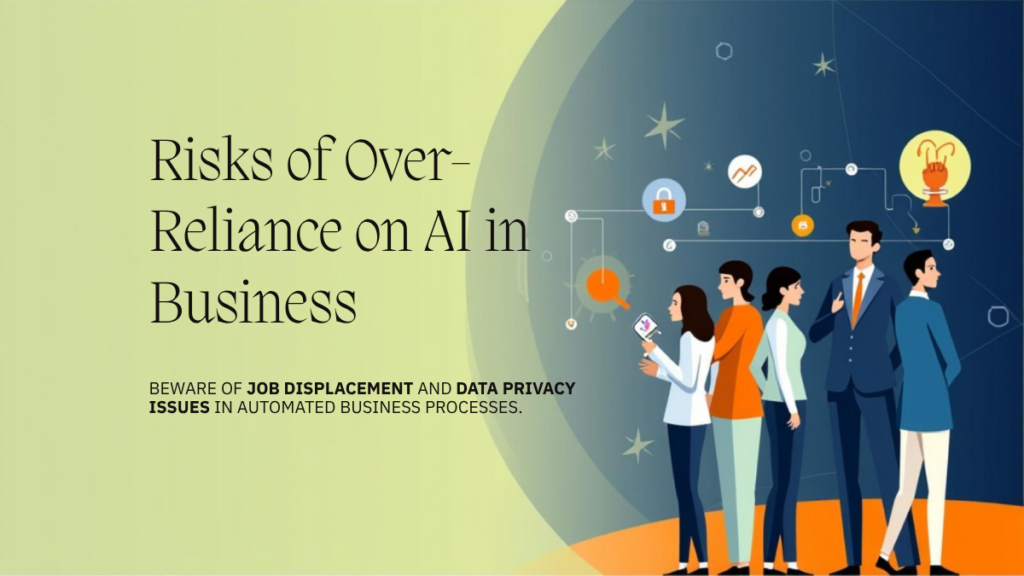
Introduction
AI is transforming the business landscape from automating mundane tasks to generating strategic insights. But with rapid adoption comes a pressing question:
In this blog, we’ll explore the growing dependence on artificial intelligence, the potential pitfalls businesses face, and how leaders can strike a healthy balance between automation and human intelligence. Whether you’re an entrepreneur, student, or executive, understanding these risks is crucial for sustainable innovation.
What Are the Risks of Over-Reliance on AI in Business?
Short answer: Over-reliance on AI can lead to operational blind spots, loss of critical human judgment, ethical missteps, data dependency, and significant reputational damage.
Let’s dive deeper into each of these risks.
Understanding the Core Concepts
What Does “Over-Reliance on AI” Mean?
Over-reliance occurs when businesses lean too heavily on AI tools without appropriate human oversight, validation, or ethical consideration. This often leads to automated decisions being trusted blindly, even when nuance or context is required.
Think of it as using autopilot in a plane without monitoring the weather—efficient in calm skies, but risky in turbulence.
1. Loss of Human Judgment and Intuition
Bolded short answer: AI lacks the emotional intelligence, ethics, and creativity humans bring to decision-making.
Explanation:
AI models operate based on historical data, logic, and learned patterns—but they do not understand context, morality, or empathy the way humans do. In fields like HR, legal affairs, or customer service, this absence can lead to tone-deaf, unfair, or even harmful decisions.
Example: Amazon scrapped an AI recruitment tool that downgraded female candidates due to biased historical data. Without human review, such errors could perpetuate discrimination.
2. Automation Blind Spots
Bolded short answer: Fully automated systems can fail silently if humans aren’t actively monitoring them.
Explanation:
AI systems are only as good as their training data and algorithms. Without human checks, businesses risk relying on “black-box” decisions they don’t fully understand.
Case Study: Knight Capital lost $440 million in 45 minutes due to a trading algorithm glitch—an expensive reminder of how automation can spiral out of control without human guardrails.
3. Bias and Ethical Issues
Bolded short answer: AI can unintentionally reinforce societal biases and ethical violations.
Explanation:
Algorithms trained on skewed or non-representative datasets can replicate and even magnify existing biases. Over-reliance on such tools without auditing mechanisms can lead to unethical outcomes—especially in sectors like finance, healthcare, and criminal justice.
Visual Tip: Insert infographic here: “Types of AI Bias (Data Bias, Algorithmic Bias, Deployment Bias)”
Statistic: A 2021 MIT study found that facial recognition software had error rates of 34.7% for darker-skinned women, compared to just 0.8% for lighter-skinned men.
4. Data Dependency and Quality Issues
Bolded short answer: AI systems are only as good as the data they’re trained on.
Explanation:
If the input data is outdated, incomplete, or inaccurate, AI outputs become flawed. Businesses that don’t vet their data sources can make decisions based on unreliable or misleading insights.
Example: A retail AI forecasting tool misread sales data during a holiday anomaly and drastically understocked inventory the following year.
5. Cybersecurity and Privacy Risks
Bolded short answer: AI systems can be targeted by adversarial attacks or leak sensitive data.
Explanation:
Hackers are developing AI-driven methods to exploit vulnerabilities in other AI systems, such as feeding them misleading inputs or extracting private information. If a business depends entirely on AI systems without cybersecurity layers, it’s leaving the door open to significant threats.
6. Reduced Workforce Skill Retention
Bolded short answer: Automation may erode employees’ skills and innovation over time.
Explanation:
If workers rely too heavily on AI tools, they may lose critical thinking, domain knowledge, and decision-making capabilities. This creates a risk where humans can no longer effectively intervene when AI fails.
7. Legal and Compliance Liabilities
Bolded short answer: Blindly trusting AI decisions can put businesses at odds with regulatory frameworks.
Explanation:
AI-driven decisions in areas like lending, employment, or healthcare are increasingly subject to regulatory scrutiny. Businesses must ensure transparency, explainability, and compliance, or face legal consequences.
Example: The EU’s AI Act mandates businesses explain high-risk AI decisions, or face penalties.
Related Questions (FAQ Section)
What is the difference between using AI and over-relying on it?
Short answer: Using AI means leveraging it as a tool; over-relying means delegating too much decision-making without oversight.
Longer explanation: Responsible use includes human-in-the-loop practices, regular audits, and fallback plans. Over-reliance ignores these safeguards.
Can over-reliance on AI affect customer experience?
Short answer: Yes. Over-automated customer service can feel impersonal and frustrating.
Longer explanation: Chatbots that don’t escalate complex issues or poorly personalized recommendations can alienate customers instead of helping them.
How can businesses detect over-reliance?
Short answer: Through regular performance reviews, feedback loops, and system audits.
Longer explanation: If decisions are being made without human intervention, critical errors are going unnoticed, or employees no longer question AI outputs—that’s a red flag.
Is AI over-reliance a threat to small businesses?
Short answer: Absolutely.
Longer explanation: Small businesses often adopt AI tools without full understanding, putting them at risk of making uninformed decisions or mishandling customer data.
How can companies balance AI use and human input?
Short answer: Use a hybrid model with clear oversight.
Longer explanation: Combine AI insights with expert review, encourage cross-functional audits, and invest in AI education for your workforce.
How to Prevent Over-Reliance on AI: A Simple Framework
- Audit Regularly: Review AI decisions and outputs for fairness, accuracy, and unintended consequences.
- Train Employees: Educate teams on AI’s capabilities and limitations.
- Keep a Human in the Loop: Always include human decision-makers in critical processes.
- Diversify Data Sources: Avoid training models on a single dataset or demographic.
- Use Explainable AI Tools: Prefer systems that provide transparency over “black-box” models.
Conclusion
AI offers remarkable advantages—but blind dependence on it can create more problems than it solves. By understanding the risks of over-reliance, businesses can build smarter, safer, and more ethical AI systems that complement rather than replace human intelligence.
Need help designing AI systems with human oversight?
Granu AI offers practical solutions to help you build transparent, compliant, and human-centered AI tools for your business.
Internal & Links
- AI Ethics Consulting – Granu AI
- What Is Explainable AI? – Granu Blog
- Contact Us – Granu AI
- https://granu.ai/how-can-small-businesses-compete-in-an-ai-driven-market/
External Sources: