
Introduction
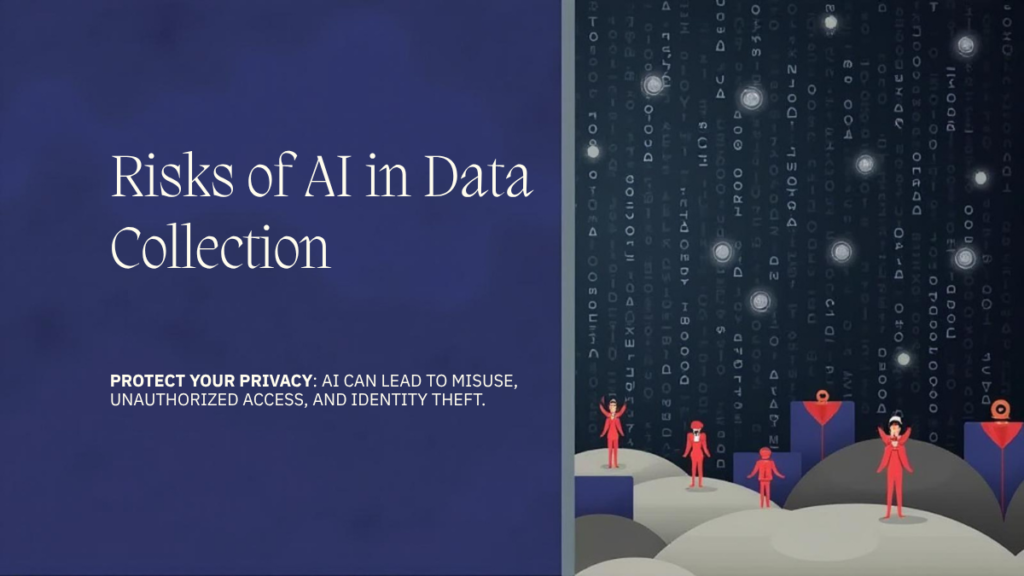
What are the risks of AI in personal data collection?
AI has become a cornerstone of modern technology powering everything from personalized shopping experiences to voice assistants and health diagnostics. But with this innovation comes a critical concern
In this article, you’ll explore:
- How AI collects personal data
- The top risks associated with AI-driven data collection
- Real-world examples that illustrate these dangers
- Best practices for managing AI and data privacy
- Answers to common related questions
What Are the Risks of AI in Personal Data Collection?
Short answer: The main risks include privacy violations, data misuse, biased decision-making, lack of transparency, and increased surveillance.
Let’s unpack these risks in detail to understand the broader implications for users, businesses, and society.
How AI Collects and Uses Personal Data
Before diving into the risks, it’s essential to understand how AI systems gather personal data:
- Behavioral tracking: AI algorithms analyze clicks, search history, and device usage to predict preferences.
- Biometric data: Facial recognition, fingerprint scanning, and voice identification feed AI models in security and retail.
- Social media content: Posts, likes, and connections help AI infer emotional state, interests, and social circles.
- Health and financial records: AI in fintech and healthcare relies on sensitive data to generate insights or provide services.
AI often collects this data passively and at scale, making it difficult for individuals to maintain control over their digital footprints.
Major Risks of AI in Personal Data Collection
1. Privacy Invasion
Short answer: AI can access and infer deeply personal information, often without explicit consent.
Explanation: AI’s predictive capabilities allow it to derive sensitive insights—such as political views, sexual orientation, or mental health—based on seemingly harmless data. This violates user expectations and can lead to psychological harm or social discrimination.
Real-World Example: In 2012, Target used predictive analytics to identify a teenage girl’s pregnancy before her family knew—by analyzing her purchase history. This is a clear case of AI invading privacy through pattern recognition.
2. Data Misuse and Security Breaches
Short answer: Collected data can be sold, leaked, or hacked, causing irreversible damage.
Explanation: Data collected by AI systems is stored in massive databases. These are high-value targets for hackers and are often sold to third parties for advertising or manipulation. Breaches can expose sensitive user information—resulting in identity theft or fraud.
Statistic: According to IBM’s 2024 Cost of a Data Breach Report, the average data breach cost reached $4.45 million, with a growing share involving AI-enabled data processing systems.
3. Algorithmic Bias and Discrimination
Short answer: AI systems can learn and perpetuate social biases, affecting fair decision-making.
Explanation: When trained on biased datasets, AI models replicate those biases. This is especially dangerous in sectors like hiring, lending, and law enforcement, where personal data can shape critical outcomes.
Visual Aid:
Infographic idea: “Types of AI Bias” (representation bias, selection bias, measurement bias, etc.)
Case Study: In 2019, Apple’s credit card algorithm was found to offer significantly lower credit limits to women than men—even when all other factors were equal.
4. Lack of Transparency and Consent
Short answer: Users often don’t know what data is being collected or how it is being used.
Explanation: AI systems are complex and operate behind opaque interfaces. This makes it difficult for individuals to provide informed consent or opt out of data collection. Terms of service are often vague or buried in fine print.
5. Mass Surveillance and Loss of Anonymity
Short answer: AI enables constant monitoring that erodes personal freedom and privacy.
Explanation: AI-powered facial recognition and geolocation tracking allow governments and corporations to monitor individuals at scale. While these tools offer benefits like crime prevention, they also create chilling effects on freedom of expression and movement.
Example: In China, AI surveillance is used extensively to monitor citizens, track behavior, and score social credit. Similar technologies are being tested globally, raising alarm among privacy advocates.
How to Reduce the Risks of AI in Personal Data Collection
While the risks are significant, proactive steps can help mitigate them.
1. Implement Privacy by Design
- Embed privacy features into AI systems from the ground up.
- Minimize data collection and enable user control over information.
2. Use Explainable AI
- Adopt AI models that provide understandable reasons for their decisions.
- Helps in identifying and correcting biases.
3. Strengthen Data Governance
- Establish strict data access protocols and audit trails.
- Regularly update data handling practices to meet evolving privacy laws.
4. Adopt Encryption and Anonymization
- Encrypt data during storage and transfer.
- Use anonymized datasets for training to avoid personal identification.
5. Comply with Legal Frameworks
- Adhere to regulations like GDPR, CCPA, and other emerging AI-specific laws.
- Offer clear data usage policies and accessible opt-out options.
FAQ: Related Questions
What is AI data collection?
Short answer: AI data collection is the process by which algorithms gather and analyze personal information.
Longer explanation: This includes behavioral data, biometric details, text inputs, and more—often processed without users’ full understanding or consent.
Why is AI data privacy important?
Short answer: It protects users from exploitation, discrimination, and security threats.
Longer explanation: Ensuring data privacy helps maintain user trust, legal compliance, and ethical AI development.
Can AI be ethical with personal data?
Short answer: Yes, with proper safeguards.
Longer explanation: Ethical AI involves transparency, consent, bias checks, and user empowerment. Many companies and researchers are developing frameworks to guide responsible use.
What industries are most affected by AI data privacy issues?
Short answer: Healthcare, finance, marketing, and law enforcement.
Longer explanation: These sectors deal with sensitive personal information and are increasingly reliant on AI, making privacy risks more pronounced.
How can individuals protect their data from AI systems?
Short answer: Be selective with app permissions and use privacy tools.
Longer explanation: Users should limit data sharing, review privacy settings regularly, and support organizations advocating for stronger data rights.
Conclusion
AI has revolutionized how personal data is collected and used, offering immense benefits—but also posing serious risks. From privacy breaches and biased decisions to mass surveillance, these concerns are real and growing.
However, with thoughtful design, regulation, and user empowerment, the risks of AI in personal data collection can be managed effectively.
Need help auditing your AI for data privacy risks? Granu AI’s compliance toolkit offers real-time evaluation and support tailored to your business.
Internal Links
- AI Ethics Consulting
- What Is Explainable AI and Why Does It Matter?
- How AI Affects Privacy Rights
- https://granu.ai/how-does-ai-handle-unstructured-data/