
Introduction
Artificial Intelligence (AI) is transforming how industries operate, from automating routine tasks to enabling predictive analytics and enhancing customer experience. But which sectors are experiencing the most profound changes?
In this post, you’ll learn:
- Which industries are most affected by AI automation
- How AI is reshaping jobs and workflows
- Real-world examples of AI implementation
- What this means for your business or career
Let’s explore the current and future impact of AI across industries.
Direct Answer: What industries are most affected by AI automation?
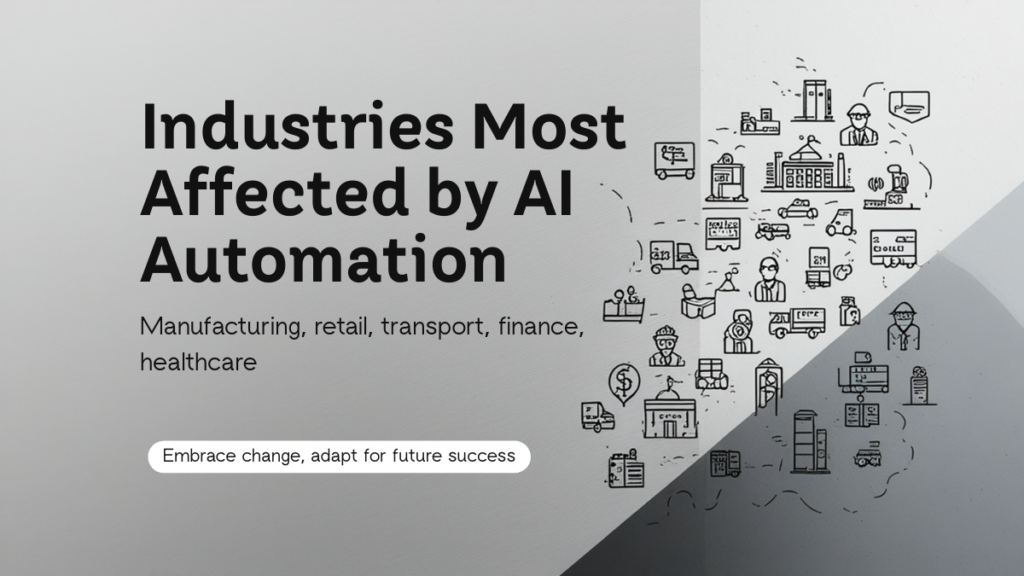
Short answer: Industries most affected by AI automation include manufacturing, healthcare, finance, retail, transportation, and customer service.
AI is significantly transforming these sectors by enhancing efficiency, reducing costs, and unlocking new capabilities.
Understanding AI Automation
What is AI Automation?
AI automation refers to the use of artificial intelligence technologies like machine learning, natural language processing, and robotics to perform tasks that previously required human intelligence.
Core Components of AI Automation:
- Machine Learning: Enables systems to learn from data and improve over time.
- Natural Language Processing (NLP): Allows machines to understand and respond to human language.
- Robotic Process Automation (RPA): Automates repetitive, rules-based tasks.
Industry Deep Dive: How AI is Transforming Major Sectors
1. Manufacturing
AI Use Cases:
- Predictive maintenance
- Quality control through computer vision
- Supply chain optimization
Example: General Electric uses AI to predict machinery failures and reduce downtime.
Impact:
- Increases production efficiency
- Reduces unplanned downtime
- Enhances product quality
2. Healthcare
AI Use Cases:
- Medical image analysis
- Predictive diagnostics
- Personalized treatment plans
Example: IBM Watson assists in diagnosing cancers by analyzing vast medical databases.
Impact:
- Improves diagnostic accuracy
- Reduces administrative workload
- Enhances patient care
3. Finance
AI Use Cases:
- Fraud detection
- Algorithmic trading
- Customer service chatbots
Example: JPMorgan Chase uses AI for fraud detection and compliance monitoring.
Impact:
- Improves risk assessment
- Enhances customer service
- Increases operational efficiency
4. Retail and E-commerce
AI Use Cases:
- Personalized recommendations
- Inventory management
- Virtual shopping assistants
Example: Amazon uses AI to power its recommendation engine, driving sales.
Impact:
- Boosts customer engagement
- Optimizes stock levels
- Enhances shopping experience
5. Transportation and Logistics
AI Use Cases:
- Route optimization
- Autonomous vehicles
- Demand forecasting
Example: UPS uses AI to optimize delivery routes, saving millions annually.
Impact:
- Reduces fuel consumption
- Increases delivery speed
- Enhances fleet management
6. Customer Service
AI Use Cases:
- AI chatbots and virtual assistants
- Sentiment analysis
- Automated ticket routing
Example: Zendesk integrates AI to triage customer inquiries.
Impact:
- Improves response times
- Reduces support costs
- Enhances user satisfaction
Supporting Data & Trends
- According to McKinsey, AI could add $13 trillion to the global economy by 2030.
- A 2023 MIT study found that 62% of companies reported cost savings from AI implementation.
FAQ: Related Questions About AI in Industries
How does AI impact employment in these industries?
Short answer: AI shifts the job landscape rather than eliminating jobs. Longer explanation: While some repetitive tasks are automated, new roles are created in AI management, data analysis, and tech development.
Which industry is likely to be disrupted next by AI?
Short answer: Legal services and education. Longer explanation: AI is starting to automate legal research and grading, making these sectors ripe for change.
What skills are needed to adapt to AI automation?
Short answer: Data literacy, critical thinking, and digital fluency. Longer explanation: Employees must understand how to interpret AI outputs and work alongside smart systems.
Are there risks associated with AI automation?
Short answer: Yes, including bias, privacy issues, and job displacement. Longer explanation: These risks require careful governance and ethical frameworks, such as those supported by Granu AI’s ethics consulting services.
Conclusion
AI automation is reshaping industries in powerful ways—from predictive healthcare to optimized logistics. Understanding these trends is essential for professionals, businesses, and students looking to stay competitive.
Need help applying AI in your business? Granu AI offers real-world support and custom solutions for ethical, scalable AI adoption.
Internal Links:
External Links: